BETTER BIDS FOR BETTER BRIDGES
A modular crossing system that helps contractors stay out of the stream and speed up installation, offering a clear path from bid to build.

Position Velpont to Strengthen Your Bid
When bidding a road crossing, the proposal needs to communicate more than price. Owners and engineers want confidence that the crossing can be built efficiently, with minimal disruption and predictable construction sequencing. Velpont helps contractors frame that story clearly.
The system uses modular precast abutment blocks combined with bridge superstructure components to create a streamlined crossing solution for spans up to 75 ft (22.8 m). Much of the installation occurs on the streambanks rather than within the channel, which simplifies staging, reduces impacts on the waterway, and accelerates installation.
This makes Velpont easier to position in a bid package. Contractors who bid Velpont propose a repeatable system, a straightforward installation sequence, and a crossing approach that addresses schedule, constructability, and site impact.
Why Contractors Propose Velpont

Streambank-Centered Installation
Velpont installations typically concentrate work on the streambanks rather than inside the channel, aligning with Stream Smart best practices. This approach simplifies staging and helps contractors plan bridge construction with fewer in-stream activities.

Predictable Construction Sequencing
Interlocking knob-and-groove block geometry helps guide placement and alignment during stacking, offering a repeatable sequence contractors can clearly explain in a proposal narrative.

Transparent, All-In Pricing
Strong crossing proposals give owners confidence in how the bridge project will be built. Velpont’s modular design supports predictable installation with fewer surprises during construction.
BRIDGE THE GAP
Proposing Velpont in a Bid Package
Contractors successfully present Velpont in bid documents by outlining a clear installation strategy and system configuration. While bidding processes and needs can vary significantly, a typical proposal narrative may include the following steps.
- Confirm crossing suitability
Identify the project as a road-stream crossing and verify the required span is within Velpont’s application range of up to 75 ft (22.8 m).
- Define the system in the proposal
Describe Velpont as a modular bridge system consisting of precast concrete abutments and bridge superstructure components.
- Present the construction approach
Explain that installation is largely focused on streambanks, with abutment block placement forming the substructure before superstructure installation.
- Outline the abutment configuration
Reference available block sizes and corner units to demonstrate how the layout will adapt to site geometry.
- Address reinforcement provisions
Note that hollow core abutment blocks allow additional rebar and cast-in-place concrete reinforcement when required by the project design.
- Outline the installation sequence
Visit our installation page for more information.
- Frame installation schedule and equipment needs
Depending on project conditions, many installations can be performed with a small crew and an excavator, simplifying construction planning.
- Verify approval and permitting
Performance, span applicability, installation methods, and regulatory compliance are project-specific and must be confirmed by the engineer of record and applicable authorities. Final design, permitting, and construction methods must be verified prior to bid submission and installation. Confirm agency approval requirements, local permitting conditions, and final engineering review prior to submitting the bid.
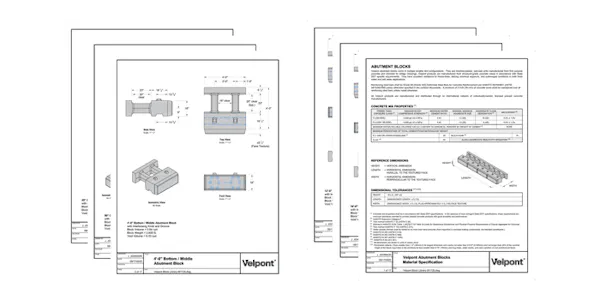
Velpont Block Library
Velpont uses a standardized library of modular precast abutment and corner blocks that simplify crossing layout and construction planning. Multiple block lengths and corner configurations allow the crossing to adapt to site conditions without custom substructure development. Wet cast concrete blocks are designed for durability in freeze-thaw, deicing chemical, and submerged environments.
Superstructure components, including edge beams, slab beams, and transition curb blocks, are currently in development and scheduled for release in late 2026 or early 2027.
Quote Your Crossing
Define your site parameters and receive a clear, contractor-focused quote built around standardized Velpont components and a practical installation approach.
Frequently Asked Questions
How long does it take to install a Velpont bridge?
Contractors and bridge installers will find that construction takes days rather than weeks, significantly faster than traditional alternatives. Velpont bridges were designed to be installed with a small crew and minimal heavy equipment, further simplifying jobsite logistics.
Does Velpont reduce permitting complexity?
Often, yes. The minimal in-stream work needed for installation can ease permitting requirements on contractors and bridge designers/engineers.
What is included in the Velpont modular crossing system?
When fully launched, the Velpont modular bridge system will comprise precast concrete substructure, superstructure, and decking components. The initial Velpont component release includes precast substructure elements such as abutment blocks and corner units. Additional superstructure materials (base blocks, deck beams, backwall and coping units) and deck panels are currently being developed and will be released in late 2026 or early 2027.
Craft a Better Crossing Proposal
For many crossing projects, the challenge is not the bridge itself. It’s the logistics of building it. Access constraints, stream impacts, staging limitations, and construction sequencing often drive schedule risk and cost. Velpont’s modular system is designed to address those realities.
With precast components that arrive ready to set, contractors can frame their proposal around a construction approach that minimizes in-stream work, reduces field-formed details, and simplifies installation planning. This allows contractors to present a crossing solution engineered to offer:
- Clear installation sequencing
- Repeatable modular components
- Reduced site disturbance
- Predictable construction planning
Instead of proposing a one-off structural solution, contractors can present a complete modular crossing system designed specifically for road-stream crossings.