INSTALLING VELPONT:

BUILD A BRIDGE IN DAYS, NOT WEEKS

Leverage Velpont’s installation simplicity and speed to install resilient road crossings in a fraction of the time required for traditional bridges.

Get Velpont

How to Install a Velpont Crossing

Fun fact: the most time-consuming process of your project may not even be the installation. It’ll be removing the failed alternative.
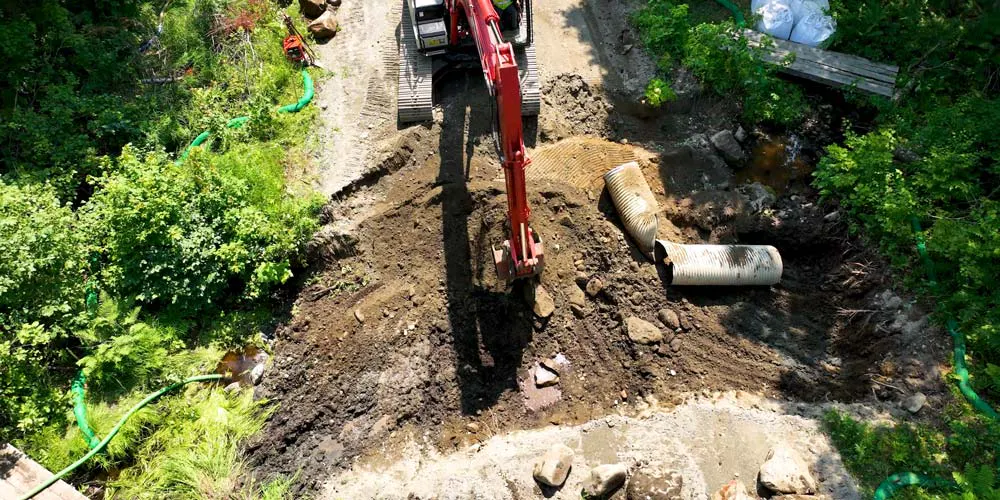
The site is cleared and excavated to establish a level, stable foundation for the abutment blocks. Crews prepare and compact a suitable base material to meet design requirements, focusing work on the banks and approaches rather than the active stream channel. Depending on site conditions and water levels, temporary dewatering measures may be required to provide safe access and achieve proper base preparation.
Crews typically use an excavator to place abutment and corner base blocks on the compacted foundation. Blocks are aligned with a string line or laser level. The first course (layer) is backfilled with clean, granular material, thoroughly compacted.
Additional courses interlock with those below using a proprietary knob-and-groove system, stacking like Lego bricks to create the necessary batter (block setback) and form sturdy, secure support walls.
The blocks’ hollow cores can be reinforced with rebar and cast-in-place concrete on site, creating a monolithic abutment that gives engineers and installers control over load capacity and ensures long-term durability.
After the abutments are in place, beams are placed on top, spanning the crossing. These components can often be handled with standard lifting equipment, such as loaders or excavators. Velpont precast concrete edge beams, slab beams, and transition curb blocks are expected to be available in late 2026 or early 2027.
Grading approaches, installing guardrails, and final site restoration complete the job. If utilized, dewatering equipment is removed. Because no streambed excavation was needed, the stream’s natural flow and habitat remain intact.
Velpont Bridge installation step image

How Does Velpont Compare to Traditional Crossing Alternatives?

Evaluate the Alternatives

What’s Needed to Install Velpont?

Additional tools may be needed, depending on the specific site characteristics and crossing design.
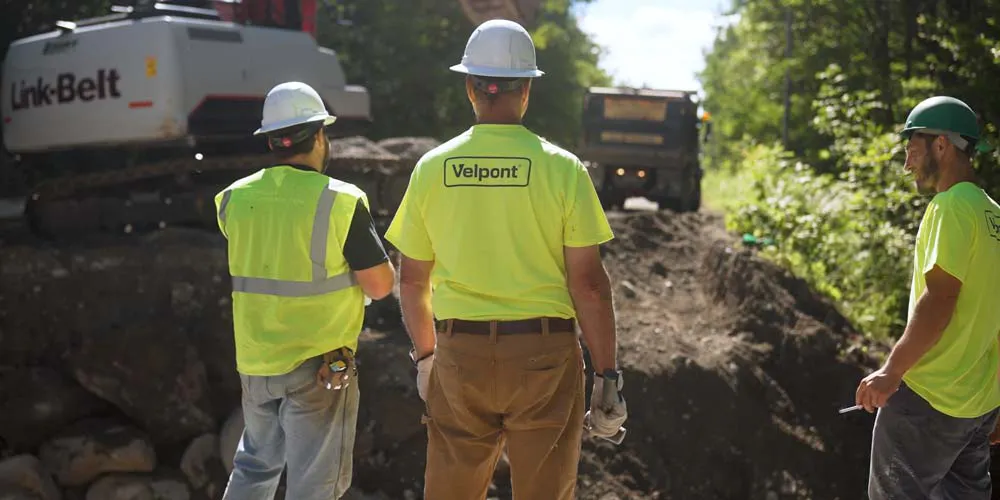
A small 3-4 person civil construction crew – typically an equipment operator and a few ground personnel – can install. Specialized bridge installation labor isn’t necessary.
A 32.5-42.5 ton (29.5-38.6 t) machine is used to set and place blocks accurately. Also handles material movement, backfilling, and site support tasks.
Attach to cast-in lifting points to safely handle and position blocks during placement.
Prepares and densifies the base material to ensure stable, uniform block support.
Establish grade, alignment, and elevations to ensure blocks install cleanly and consistently.
Pry bars, hammers, and wrenches used for minor field fitting, alignment adjustments, and rigging setup.
This may include rebar placement and concrete-pouring tools (when on-site reinforcement is specified), as well as dewatering equipment.
Velpont installation equipment image

Install a Custom Crossing Solution.

Every Velpont price is built around your site, span, and configuration, not one-size-fits-all estimates.

Price Your Crossing

Frequently Asked Questions

How long does it take to install a Velpont bridge?

Contractors and bridge installers will find that construction takes days rather than weeks, significantly faster than traditional alternatives. Velpont bridges were designed to be installed with a small crew and minimal heavy equipment, further simplifying jobsite logistics.

What equipment is needed to install a Velpont bridge?

Minimal heavy equipment is required: a 32.5-42.5 ton (29.5-38.6 t) loader or excavator, lifting equipment, plate compactor or roller, concrete vibrator, and hand tools. Depending on the site and design needs, rebar and concrete placement equipment, post-tensioning jacks, dewatering pumps, hoses, filtration systems, cofferdams, and other specialized equipment may be necessary.

What's the typical crew size needed to install Velpont?

Small civil construction crews—often 3–5 individuals—can efficiently install a Velpont system. A highly experienced or specialized bridge installation crew isn’t necessary.

Why does minimal in-stream installation work matter?

Minimizing in-stream work protects the long-term health of the waterway. Traditional culverts often require streambed excavation, which can disrupt natural flow, damage habitat, and create scouring or fish passage barriers. Velpont’s open-bottom design keeps heavy work on the banks, helping preserve natural stream conditions and aquatic connectivity. It can also simplify permitting and reduce construction risk by limiting disturbance within the channel.