Comparing Crossings: Velpont vs Cast-in-Place Concrete Bridges
Avg. Read Time: 4 min, 13 sec
Bridging the Gap
Short on time? Here are this article’s key takeaways…
Cast-in-place bridges offer design flexibility but require longer timelines and more field-dependent construction
Velpont modular bridges simplify installation with precast components and faster, more predictable schedules
Hydraulic and environmental performance differ mainly in construction impact, with Velpont minimizing in-stream disturbance
Total project value depends on installation cost, risk, and lifecycle performance, not just initial material pricing
Concrete cast-in-place bridge structures have long been a standard solution for road–stream crossings. Built by forming, reinforcing, and pouring concrete on-site, these structures can be customized to meet a wide range of span, load, and geometric requirements.
They are widely used in transportation infrastructure because of their flexibility and structural capacity. However, that versatility comes with trade-offs: longer construction timelines, greater reliance on ideal field conditions, possible weather delays, and increased coordination demands among trades.
Because they are installed within the roadway embankment, box culvert construction typically involves excavating the channel, installing the culvert structure, and rebuilding the roadway above it. When properly designed and installed, these structures can provide reliable service for decades.
The Velpont modular bridge system offers an alternative to cast-in-place concrete bridges. Velpont is an open-span, precast concrete solution designed to simplify installation while maintaining long-term durability. Rather than building the structure entirely in place, Velpont uses factory-produced components assembled on site, shifting much of the complexity away from the jobsite.
Installation
Installation methods shape project timelines, labor demands, and overall risk. The differences between a modular system and a fully site-built structure become most apparent during construction, where sequencing and field conditions directly affect outcomes.
Cast-in-place bridges offer flexibility, but introduce more field variables. Velpont emphasizes repeatability and schedule control by shifting complexity off-site.
Velpont
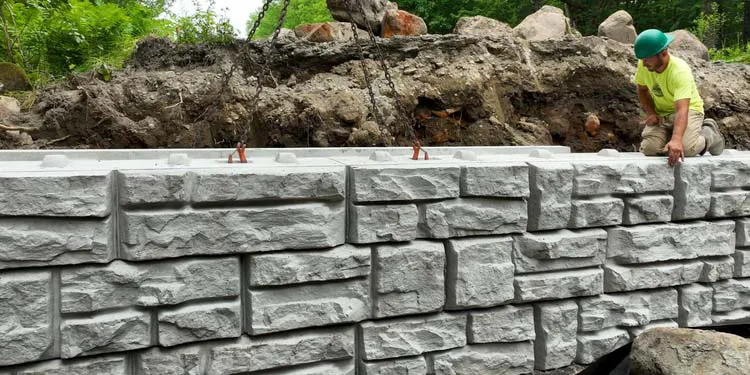
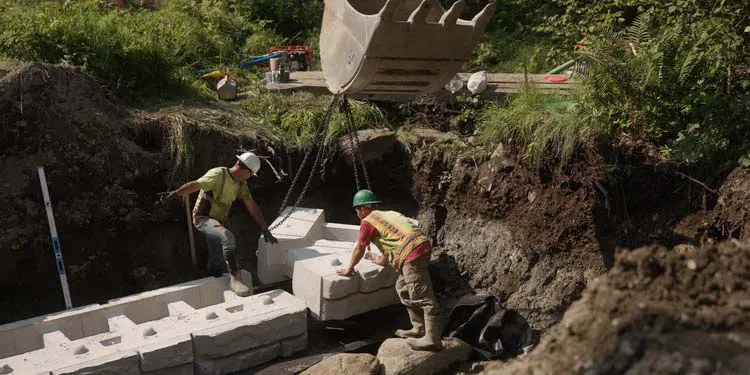
- Precast abutment blocks are manufactured off-site and delivered ready to install
- Modular components stack and interlock using a knob-and-groove system
- Installation typically occurs from the streambanks, limiting in-channel work
- Small crews (3–5 people) using standard equipment can complete the installation
- Many crossings are completed in days once site prep is complete
Cast-in-Place Concrete Bridges
- Formwork, reinforcement, and concrete placement are completed entirely on site
- Construction requires staging, forming, pouring, and curing sequences
- Often involves extended in-stream or near-channel work, depending on foundation design
- Requires multiple trades and inspection phases
- Construction timelines are often measured in weeks or months, and are greatly influenced by -weather and curing conditions
Hydraulic Performance
Hydraulic performance determines how a crossing handles water, sediment, and debris over time. Both solutions can be engineered to meet hydraulic requirements, but their interactions with the stream and construction methods can yield different outcomes.
Both systems can deliver strong hydraulic performance. The key difference is construction impact, where Velpont is designed to minimize disturbance during installation.
Velpont
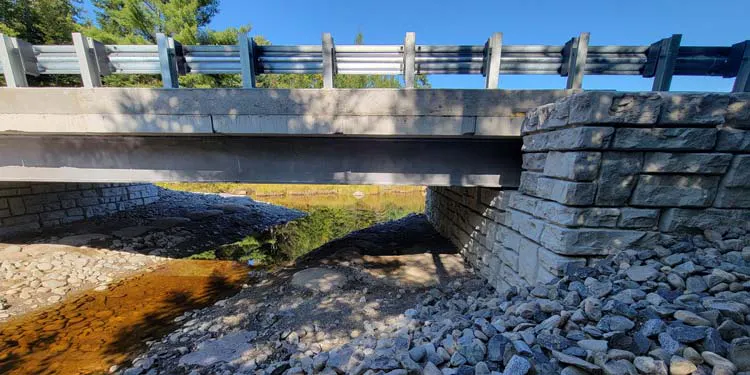
- Open-span bridge that supports the roadway above the stream channel
- Preserves the natural streambed and channel shape
- Allows sediment and debris to move through naturally
- Reduces the likelihood of flow constriction and debris blockage
Cast-in-Place Concrete Bridges
- Typically open-span, depending on design
- Can be engineered for high hydraulic capacity
- Performance depends on foundation type, span configuration, and site-specific design
- Construction activities (e.g., cofferdams, provisional works) may temporarily alter flow conditions
Durability and Maintenance
Durability is influenced by materials, manufacturing conditions, and installation quality. Over time, these factors affect maintenance needs, inspection cycles, and overall lifecycle performance.
Both solutions rely on reinforced concrete, but Velpont benefits from controlled manufacturing and repeatable installation, while cast-in-place depends more on field execution.
Velpont
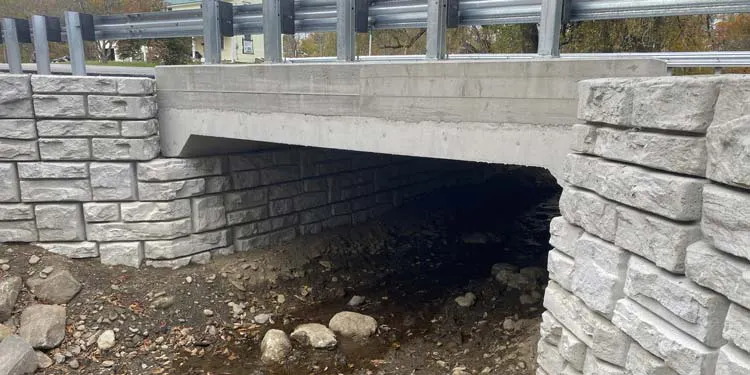
- Constructed from reinforced wet cast concrete designed for severe freeze–thaw exposure
- Produced in controlled environments for consistency in precast manufacturing facilities
- Hollow core blocks allow additional on-site reinforcement, forming a monolithic structure
- Projected service life exceeds 75 years
Cast-in-Place Concrete Bridges
- Built with reinforced concrete placed in field conditions
- Highly durable when properly designed and constructed
- Performance can be influenced by curing conditions, workmanship, and environmental exposure
- May require periodic inspection, maintenance, or rehabilitation over time

Environmental Considerations
Road–stream crossings influence stream health, habitat continuity, and long-term landscape stability. The most meaningful differences often occur during construction, when disturbance to the channel and surrounding banks can have lasting effects.
Both Velpont and cast-in-place bridges can support long-term outcomes, but Velpont is designed to minimize construction-phase impacts and preserve natural conditions with less disruption.
Velpont
- Open-bottom design preserves the natural streambed
- Installation often avoids or minimizes in-stream work
- Maintains natural sediment transport and channel stability
- Supports aquatic organism passage and wildlife movement
- Reduces turbidity risk during construction
Cast-in-Place Concrete Bridges
- Final structure can support natural stream conditions when designed appropriately
- Construction often requires temporary in-stream work (cofferdams, excavation)
- Greater potential for short-term disturbance during construction
- Environmental impact depends heavily on construction methods and site controls
Cost
Project cost is shaped by more than materials. It reflects schedule, labor, risk, and long-term performance. Understanding how each approach manages these factors helps stakeholders evaluate total project value.
Cast-in-place bridges suit highly complex, truly custom designs, while Velpont is often selected for schedule certainty, reduced risk, and lifecycle value.
Velpont
- Raw material concrete costs for precast Velpont and a cast-in-place bridge are similar.
- Faster installation can reduce labor, equipment, and traffic disruption costs
- Defined installation process improves cost predictability
- Eliminates extensive formwork, curing time, and prolonged site presence
- Strong lifecycle value due to durability and reduced maintenance
Cast-in-Place Concrete Bridges
- Comparable materials cost between solutions.
- Labor-intensive construction increases exposure to schedule and cost fluctuations
- Weather, curing time, and site conditions can introduce delays
- Greater coordination and staging requirements may increase indirect costs
The Bottom Line
Choosing the right crossing solution requires balancing performance, constructability, and long-term outcomes, as each project brings its own site constraints, regulatory considerations, and stakeholder priorities.
Cast-in-place bridges offer maximum design flexibility, making them well-suited for complex or highly customized applications, while Velpont modular bridges provide a streamlined, repeatable solution for small- to medium-span crossings.
For many stakeholders, including municipalities, engineers, contractors, and conservation groups, the decision ultimately comes down to considering customization versus constructability, installation costs, and construction timeframe, and overall site impact.